
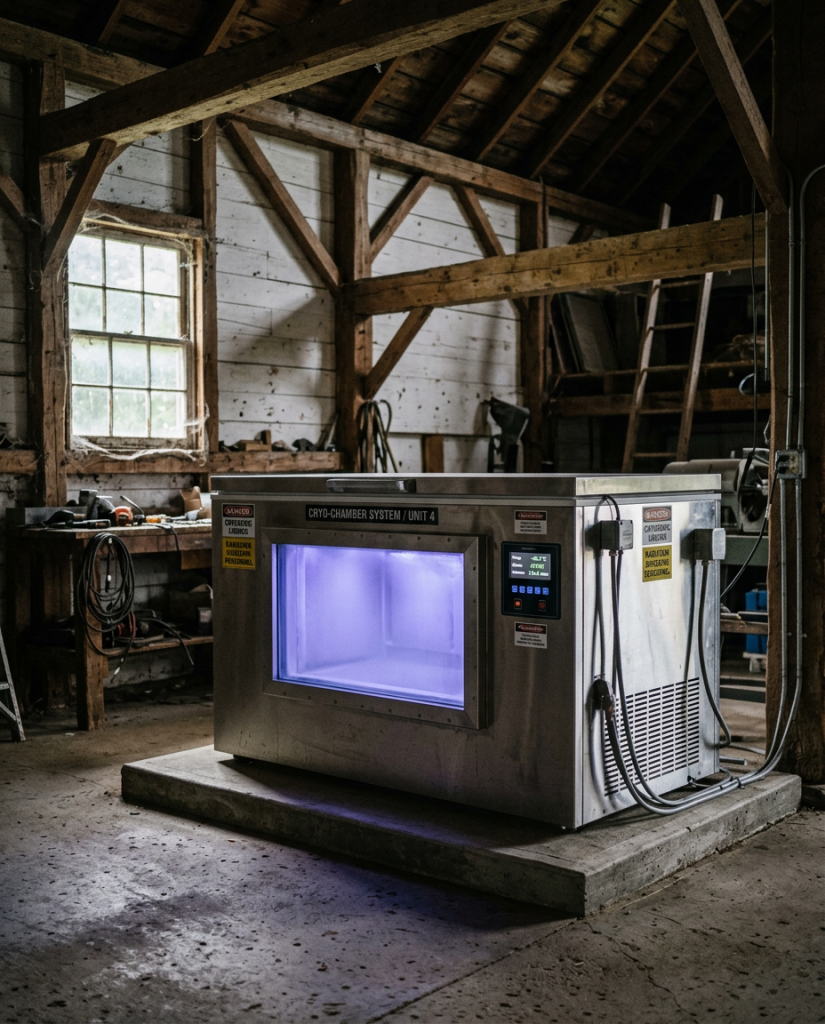
As recycling programs falter and landfills overflow, a small band of Vermont innovators is betting that the answer to humanity’s waste crisis is the most destructive object in the known universe — currently housed in a converted milking parlor outside Fairfield
By Claude Chatwell, Science and Sustainability Correspondent
FAIRFIELD, Vt. — On a windless April morning, Dale Petrowski lifts the steel hatch on what appears to be an ordinary chest freezer and drops in a black plastic container that once held a supermarket rotisserie chicken. He swings the hatch shut and gives the latch a practiced quarter-turn, with the unbothered ease of a man who long ago stopped glancing at the radiation badge clipped to his collar. Only then, behind a thick leaded window, there is a brief, soundless flash of violet light. The container is gone. Not melted, not compacted, not baled and shipped to a sorting facility in Malaysia. Gone.
“That’s the whole demo,” Mr. Petrowski said. “No residue. No ash. No microplastics in anybody’s bloodstream. It is the only recycling system on Earth with a one-hundred-percent diversion rate, and I mean that in the most literal possible sense.”
Mr. Petrowski, 49, a former dairy-equipment dealer who now describes himself as a “waste futurist,” is one of a handful of Vermonters who believe the state’s mounting refuse problem has a clean, final, and admittedly unconventional answer: a domesticated black hole.
Holey Moley
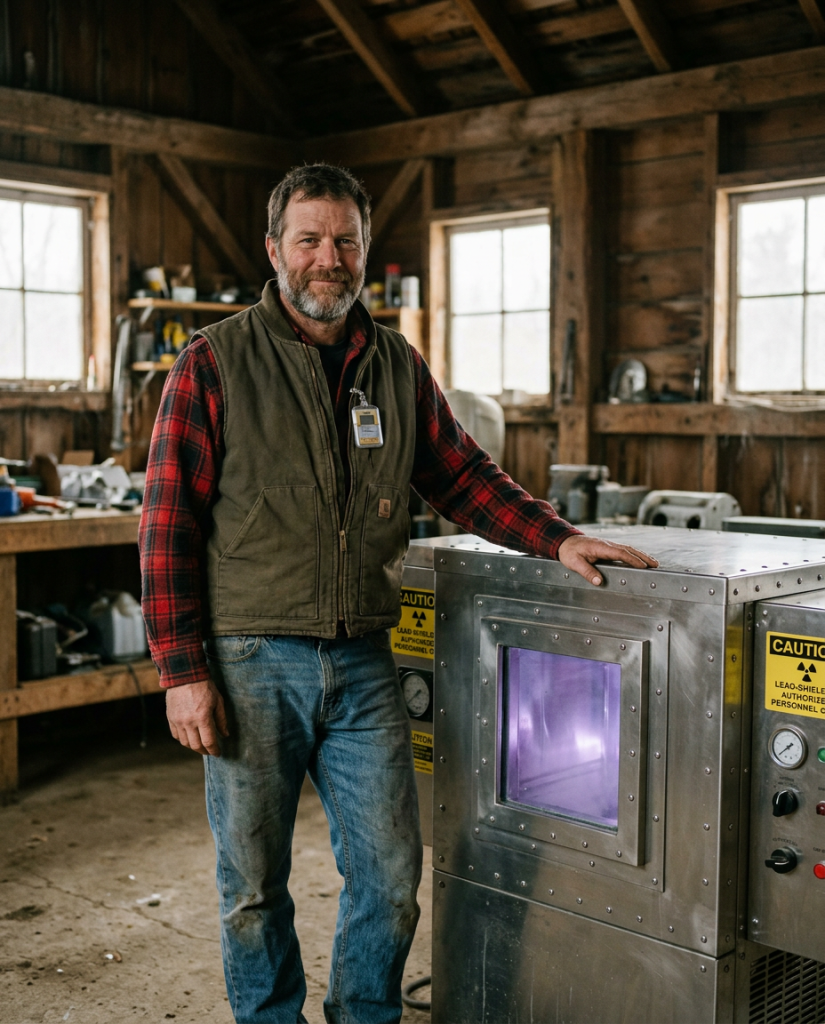
The device at the center of Mr. Petrowski’s barn — which his startup markets as “Holey Moley” — contains, he explained, a charged black hole roughly the mass of Mt. Mansfield but considerably smaller than an atom. The product’s official slogan, stamped on the side of every model, reads: “I can’t believe I ate the whole thing!”
A black hole, for those who have not kept up with astrophysics, is what forms when matter is crushed to a density so extreme that its own gravity seals it off from the rest of the universe. Squeeze the entire planet Earth down to the size of a marble and it would become one. Nothing crosses its outer edge, known as the “event horizon.” It’s an apt name, because it’s the point of no return. Nothing can climb back out: not a pebble, not a banana peel, not even a ray of light, which is why the objects are black.
Mr. Petrowski’s specimen weighs as much as a mountain, yet it’s smaller than a proton inside an atom. So concentrated is its mass that it would sink through solid rock the way a stone sinks through water.
“People get hung up on the size,” he said. “They ask, ‘how do you hold something that small?’ You can’t hold it, it’s too heavy.”
Instead, his device gives the black hole a negative charge, kind of like when you rub a balloon to give it static electricity. Then you cradle the charged hole in a magnetic field, like a marble balanced on a fountain of water. “We top up the charge twice a day,” he said. “There’s an app for that.”
The “nothing escapes from a black hole” rule has a single, subtle loophole. In the 1970s, the physicist Stephen Hawking showed that a black hole’s edge slowly leaks energy back into the universe, in the form of radiation. The smaller the black hole, the more it leaks. Mr. Petrowski’s black hole, minuscule by cosmic standards, does not so much leak as blaze, producing a steady stream of high-energy gamma rays. It is this radiation, captured by the shell enclosing Holey Moley, that the machine harvests and sells as power.
Waste dropped through the hatch is funneled, by a system Mr. Petrowski declined to describe in detail, “for proprietary reasons,” toward the suspended singularity (another name for a black hole), where it is consumed at a rate of roughly one gram per second. The energy released in the process is captured by a surrounding shell and converted to electricity.
“That’s the part nobody expects,” he said, brightening. “It doesn’t just take your garbage. It pays you for it, by producing energy. This barn sells enough power back to the grid to run about four thousand homes. The trash isn’t a cost, it’s the fuel.”
Asked how often Holey Moley must be emptied, Mr. Petrowski paused.
“That’s the beautiful part,” he said. “It is never full. It will never be full. You could feed it the entire town of Fairfield and it would ask for the next town over.”
There is, he added, a certain satisfaction in the finality of it.
“Everything that goes in is gone. For good. No residue, no follow-up, no ‘we’ll get back to you,’” he said. “You want to know the only other thing in my life that vanishes that completely?” He produced a thick, dog-eared folder. “The appeals I file with my health insurance company. I send them off, and it’s like they go straight into a black hole.” He tilted his head toward the barn. “Difference is, Holey Moley has never once asked me for a referral.”
Early Adopters
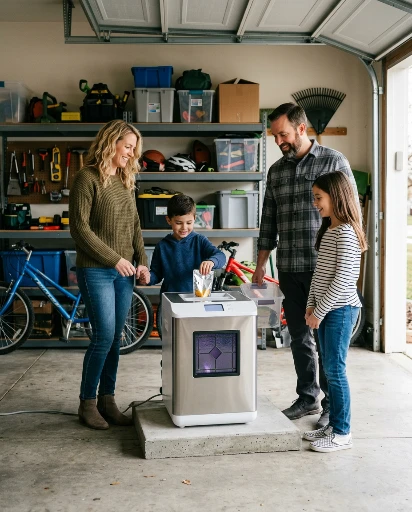
Forty minutes to the west, in a tidy split-level outside St. Albans, the Ouimette family installed one of the first residential units last fall. It’s a countertop model roughly the size of a microwave, mounted, per the installer’s firm instructions, on a reinforced concrete pad in the garage.
“The kids love feeding it,” said Marie Ouimette, 41, watching her youngest slide a juice pouch through the slot. “It’s become a whole ritual. One thing in the morning, one thing at night. Very ceremonial.”
The household’s monthly electric bill, she noted, now runs a credit of approximately $90,000, a figure the utility has dispatched two technicians and one increasingly formal letter to dispute.
The transition was not entirely without incident. Mrs. Ouimette acknowledged the loss of a set of car keys, a wedding ring, and “most of a trampoline.”
It has also, she noted, retired a certain time-honored excuse — by making it true.
“My son came downstairs last week and announced he couldn’t hand in his book report,” she said. “I asked him where it was. He looked me right in the eye and said, ‘The black hole ate it.’” She paused. “And that’s the trouble. I can’t prove he’s wrong.”
Academic Assessment

Dr. Priya Venkataraman, a physicist at the University of Vermont who studies gravitation, offered what she described as “qualified, heavily footnoted, and frankly worried” support for the technology.
“I want to be fair to Mr. Petrowski,” she said. “It’s true that nothing escapes a black hole. So in that narrow, technical sense, yes, his diversion rate is exactly one hundred percent. I’d only point out that the category of things that do not escape a black hole is quite broad. It includes the recycling. It also includes the kitchen, the barn, and — given a sufficiently long afternoon — most of Franklin County.”
Dr. Venkataraman’s deeper worry was what happens if the magnetic cradle ever fails.
“You have to remember what is actually sitting in that barn,” she said. “A million tons of weight squeezed into a speck of dust. The only thing holding it up is the magnetic field. No floor on Earth could handle that job, because a black hole wouldn’t rest on a surface. It will fall straight through it. Concrete, basement, bedrock, the Earth’s mantle, right to the core. For something that dense, solid stone may as well be air.”
In that event, she explained, Holey Moley would not crash or explode. It would simply begin to sink, drawn down by its own staggering weight, boring through the floor and into the ground beneath, slowly at first and then faster, falling toward the center of the planet.
“And it does not stop when it reaches the middle,” she said. “It keeps eating. Rock, iron, molten core, all of it is just more fuel. And it grows. Give it enough years and there is no more Earth. Only the black hole, and everything the Earth used to be, now inside it.”
She allowed that this scenario remained, in her professional judgment, “unlikely in any given week.”
A Regulatory Gray Area
State officials confirmed that the units occupy an unsettled position in Vermont law. The Agency of Natural Resources has not established a pathway for certifying a black hole as residential waste infrastructure, and a spokesperson noted that current building code “does not contemplate appliances that may, over time, relocate themselves downward.”
One commercial unit in Hardwick is reported to have descended several feet below its original installation over the winter. Mr. Petrowski characterized the report as “overblown.”
“It settled,” he said. “Things settle in Vermont. We have a frost line. I’m not going to pretend a little settling is the same as a planetary event.”
Environmental advocates have raised a separate objection. Because the consumed matter is released as a torrent of high-energy gamma radiation, critics argue the technology does not so much eliminate waste as transfer it from the landfill to the electromagnetic spectrum.
“We have not made the garbage disappear,” said one analyst with the Conservation Law Foundation, who asked not to be named pending further study. “We have converted it into a form of light that can pass through a human being. Whether that counts as an emission is, at present, a philosophical question, and I am not the philosopher.”
The product’s carbon-neutral certification remains, a company representative said, “pending.”
The Old Guard
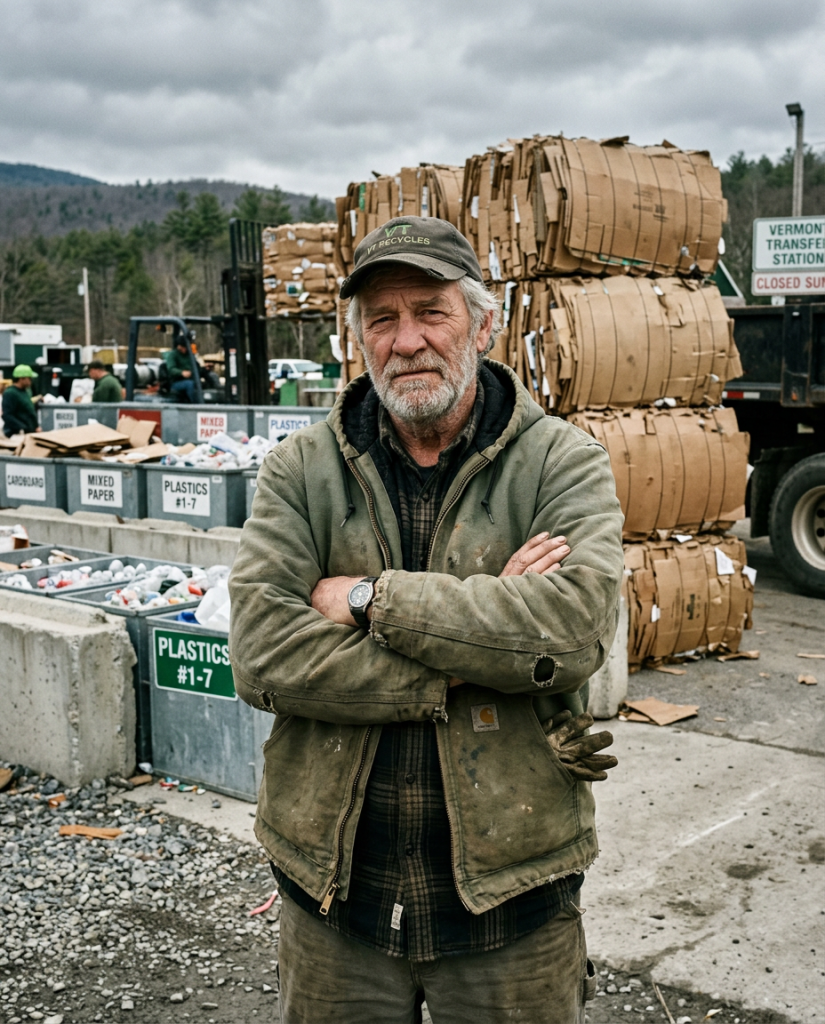
Not everyone in Vermont’s waste community has welcomed the new approach. Wendell Pratt, who has managed a Lamoille County recycling center for thirty-one years, regards Holey Moley with open contempt.
“We spent two generations teaching people to rinse the jar, peel the label, know your number-two from your number-five plastic,” Mr. Pratt said, standing among neatly sorted bins of corrugated cardboard. “It’s a discipline. It’s almost a spiritual practice. And now I’m told the future is a magic hole that eats everything and asks no questions? Where’s the mindfulness in that?”
Mr. Pratt has helped organize a group, Vermonters for Honest Disposal, that has petitioned the legislature to require all waste to be “physically transported to a fixed location and to be demonstrably still in existence.” He conceded that his own facility has lost a third of its volume to residential units in the past year.
Asked whether he might install one himself, Mr. Pratt looked for a long moment at the mountain of flattened boxes behind him.
“A man ought to know where his garbage went,” he said at last. “Be able to point to it. Look it in the eye, if it comes to that. I’m not handing mine to something that won’t even give a receipt.”
The Industry View
The plastics industry, by contrast, has greeted the development with something close to elation. A representative of a national packaging trade group, reached by phone, said the technology “completely reframes the conversation.”
“For years we’ve been on the defensive about single-use,” the representative said. “Reduce, reuse, the whole catechism. But if the waste stream simply ceases to exist on contact, if it becomes electricity, then why on Earth would anyone reduce anything? This validates disposability at the deepest level. We’re calling it Beyond Zero Waste.”
Looking Forward
Back in Fairfield, Mr. Petrowski walked his visitor to the barn door as the afternoon light lit up the far pasture. Inside, Holey Moley hummed almost inaudibly, suspended in its magnetic cradle, quietly converting the day’s accumulated refuse into power for a town that mostly did not know it was there.
“People ask me if this is really recycling,” he said. “And I get it. There’s no blue bin. There’s no truck. There’s no comforting little arrow-triangle on the bottom. But I wake up at five. I check the charge. I shovel the intake hopper — less to shovel than the old days, granted, but I shovel. My hands smell like ozone. My wife says I talk about containment fields in my sleep.”
He looked back through the door at the faint violet glow.
“If that’s not recycling,” Dale Petrowski said, “I don’t know what is.”
As this reporter walked back to his car, he noticed that the barn sat a few inches lower than the woodshed beside it. Inside, the violet light held steady, patient, turning trash into electricity, and dropping, by some small fraction of an inch each year, toward the center of the Earth.
Claude Chatwell covers science and sustainability for this publication. His previous work includes “The Compost Wars: A Family Divided” and “Are Solar Panels Simply Too Bright?”
Leave a Reply